
Conceptualizing Violence in Space as a Flow
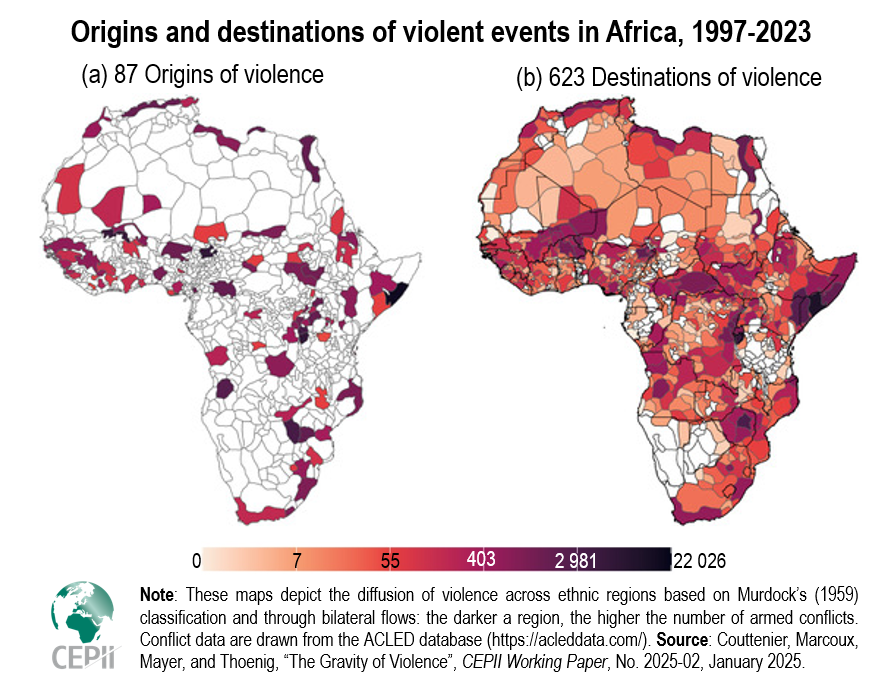
Many analyses of armed conflicts fail to take into account the spatial origins of combatant groups, as well as the competition among them on predation markets that underlies the diffusion of violence.
By Mathieu Couttenier, Julian Marcoux, Thierry Mayer, Mathias Thoening
 Post
PostA publication by CEPII fully integrates this spatial dimension into the interactions between economic factors and armed conflicts. These can be represented as interregional flows between regions of origin and destination within a geography in which employment is divided between production and fighting activities. Income in the productive sector is linked to both local and distant sales. Likewise, in the military sector, fighters forcibly appropriate a share of local as well as extra-local income. Interregional frictions affect both the shipment of produced output and the predation of revenues generated beyond ethnic and national borders.
A simulation of the consequences of an increase in economic productivity linked to the actions of Boko Haram in the Kanuri ethnic region of origin in West Africa shows that competition in the market for appropriation shapes the spatial reconfiguration of violence. The resulting pacification extends well beyond the region of the initial shock.
To go further, see The Gravity of Violence.
A simulation of the consequences of an increase in economic productivity linked to the actions of Boko Haram in the Kanuri ethnic region of origin in West Africa shows that competition in the market for appropriation shapes the spatial reconfiguration of violence. The resulting pacification extends well beyond the region of the initial shock.
To go further, see The Gravity of Violence.
< Back