
Economic Integration of Non-European Immigrants: Difficulties That Ease Over Time
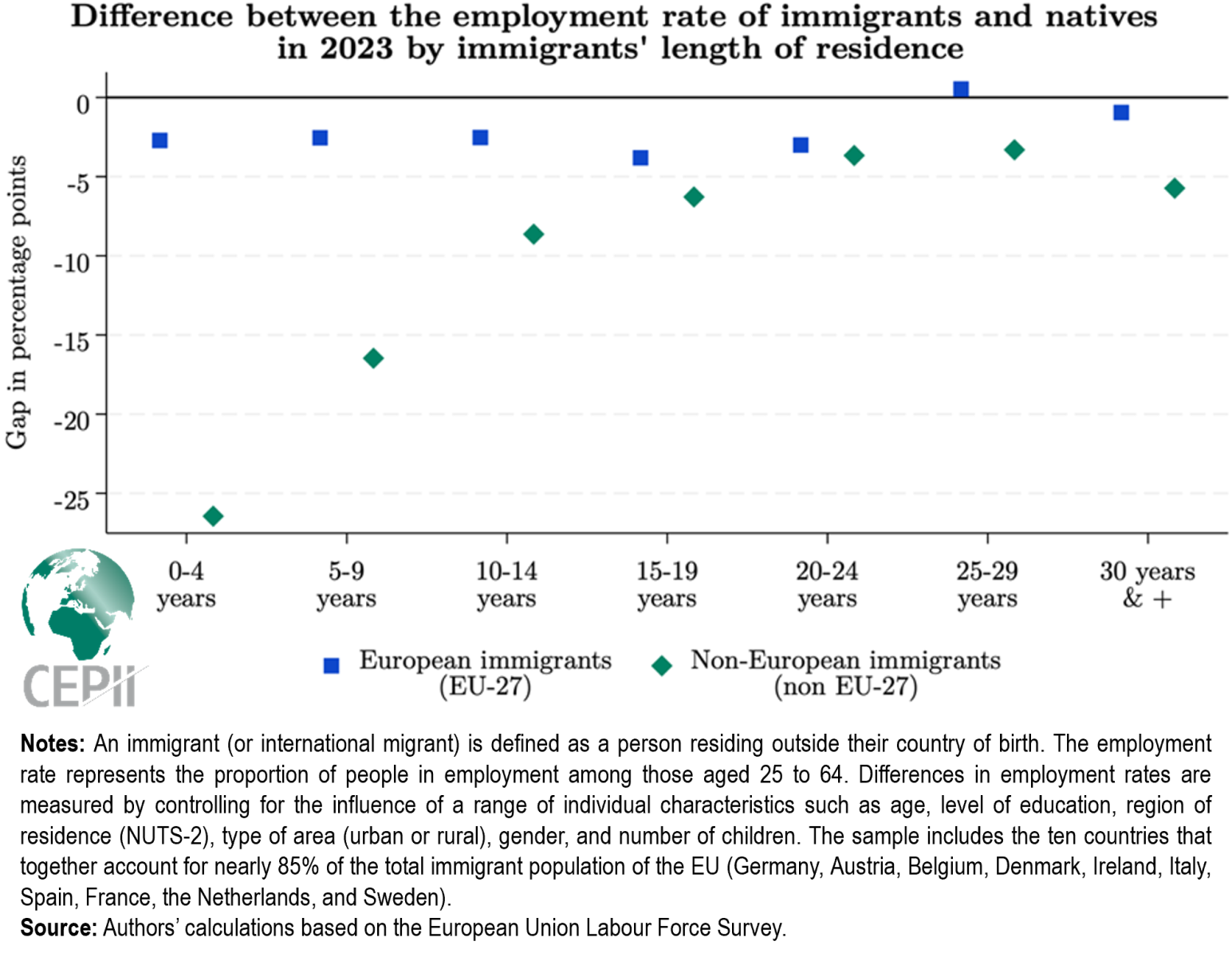
Within the ten main host countries of the European Union (EU), non-European immigrants (born outside the EU) face notable difficulties in economic integration. With comparable socio-economic characteristics, their employment rate is on average 11 percentage points lower than that of native-born individuals.
By Anthony Edo, Jérôme Valette
 Post
PostThis gap is significantly smaller for European immigrants (born within the EU), for whom it is only around 2 percentage points.
The difference in employment rates between European immigrants and natives varies little depending on immigrants’ length of residence. By contrast, the gap for non-European immigrants is larger in the first years and then decreases over time: more than 25 percentage points for those with less than five years of residence, falling to around 10 points after ten years, and stabilizing at about 5 points after more than twenty years.
Several measures can accelerate this convergence: job-search assistance, recognition of qualifications, vocational and language training, as well as policies that promote institutional recognition and the stabilization of immigrants’ status (naturalization, faster asylum procedures, and the regularization of undocumented migrants).
To go further, read Naturalisation, asile, régularisation : des leviers en faveur de l’intégration économique des immigrés and Entre immigration et marché du travail, des liens plus complexes qu’il n’y paraît.
The difference in employment rates between European immigrants and natives varies little depending on immigrants’ length of residence. By contrast, the gap for non-European immigrants is larger in the first years and then decreases over time: more than 25 percentage points for those with less than five years of residence, falling to around 10 points after ten years, and stabilizing at about 5 points after more than twenty years.
Several measures can accelerate this convergence: job-search assistance, recognition of qualifications, vocational and language training, as well as policies that promote institutional recognition and the stabilization of immigrants’ status (naturalization, faster asylum procedures, and the regularization of undocumented migrants).
To go further, read Naturalisation, asile, régularisation : des leviers en faveur de l’intégration économique des immigrés and Entre immigration et marché du travail, des liens plus complexes qu’il n’y paraît.
< Back