
Military Alliances: A Major Commercial Stake
Beyond national security issues, military alliances play an essential role in securing international trade. Their redefinition could lead to a major reorientation of global flows.
By Matteo Neri-Lainé
 Post
PostIn a scenario of geopolitical fragmentation, where the United States withdraws from all alliances, the Sino-Russian bloc is strengthened, and NATO is reoriented around Europe, the commercial and economic consequences would be markedly different on either side of the Atlantic.
The United States could suffer a notable economic loss of nearly 4% of their real income, pulling Canada and Mexico along with them due to their trade dependence, while Europe, thanks to its trade integration and enhanced cooperation, could emerge as the winning bloc with an average gain of welfare by 3%. The major European countries, already highly integrated, could see little change. Countries joining this network, however, could benefit from substantial gains.
The fragmentation of alliances would have a relatively neutral impact on China. Russia, however, would likely be adversely affected, as it would lose the benefits of agreements inherited from the post-Cold War détente.
For further reading, see Sovereign Gravity: The Military Alliance Effect on Trade.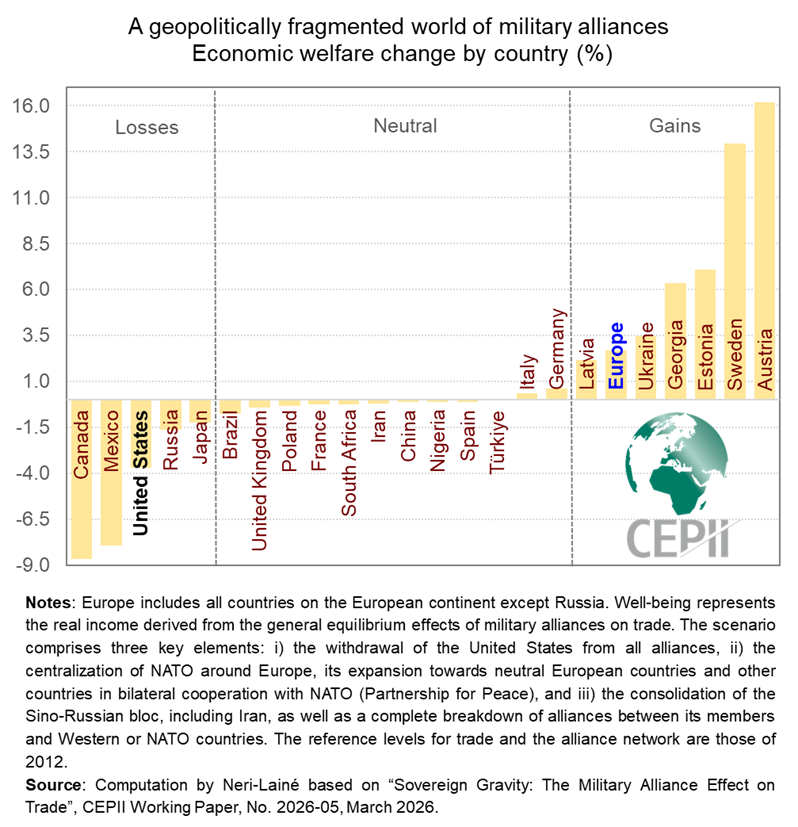
< Back