

United States: The Security Paradox of Trade Decoupling from China
The growing dependence of the United States on Chinese goods has increased the economic cost of geopolitical disputes with China for the U.S. economy. The United States therefore faces a fundamental security dilemma: while decoupling may strengthen its diplomatic bargaining power, it may also fuel a costly escalation of tensions.
By Thierry Mayer, Isabelle Méjean, Mathias Thoening
 Post
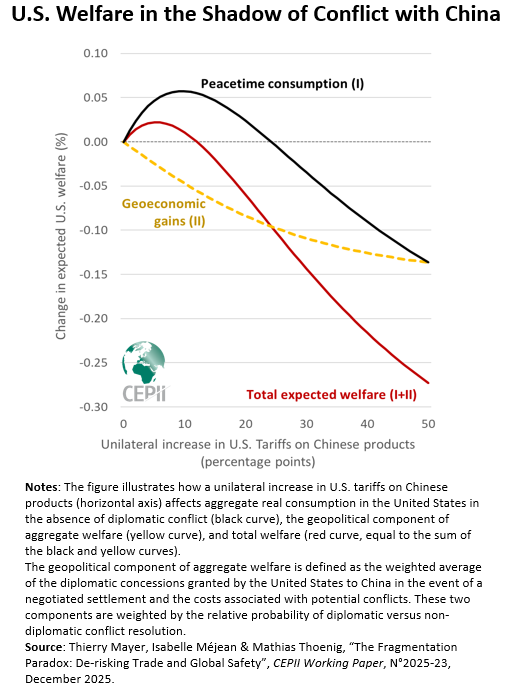
PostUsing a model calibrated on global trade flows, we quantify the cost of Sino-American conflicts, defined as the diplomatic concessions required to achieve a negotiated settlement, augmented by the costs of confrontation should diplomacy fail. We then assess the effects of trade decoupling through an increase in U.S. tariffs on Chinese products.
The figure shows that moderate decoupling can raise real consumption through tariff revenues (black curve). Beyond a certain threshold, however, losses in purchasing power dominate. Decoupling also increases the cost of geopolitical conflicts (yellow curve). The model therefore highlights a “security paradox”: by increasing the conflictual nature of Sino-American relations, decoupling reduces the expected geo-economic gains, such that its effect on U.S. household welfare is smaller than in the absence of geopolitical tensions (red curve relative to the black curve).
For further reading, see The Fragmentation Paradox: De-risking Trade and Global Safety.
The figure shows that moderate decoupling can raise real consumption through tariff revenues (black curve). Beyond a certain threshold, however, losses in purchasing power dominate. Decoupling also increases the cost of geopolitical conflicts (yellow curve). The model therefore highlights a “security paradox”: by increasing the conflictual nature of Sino-American relations, decoupling reduces the expected geo-economic gains, such that its effect on U.S. household welfare is smaller than in the absence of geopolitical tensions (red curve relative to the black curve).
For further reading, see The Fragmentation Paradox: De-risking Trade and Global Safety.
< Back